
Starlink delivers internet from a constellation of thousands of small satellites1 flying in low orbit, close enough to the ground that a signal reaches a user in a few hundredths of a second rather than the long delay of traditional satellite service parked far out in space.2 The idea of internet from orbit is decades old. What changed was the cost of getting there.
Understanding how it works means understanding why low orbit matters, why launching thousands of satellites only recently became affordable, and what the system still cannot do.
The old idea, revived
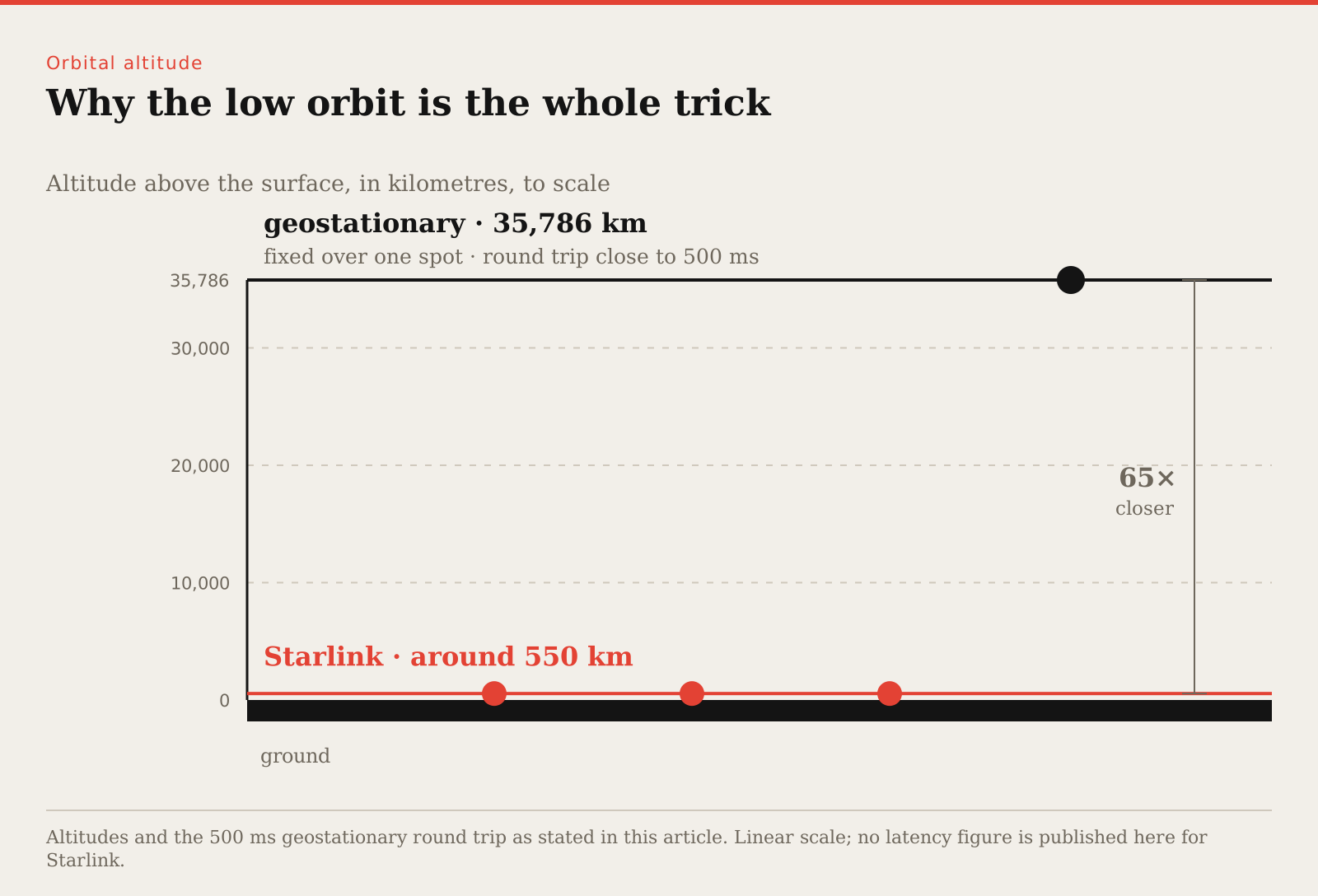
Delivering internet from space is not new. Earlier satellite services placed a small number of large satellites in a very high orbit, where each one could cover a huge area from a fixed position in the sky. That arrangement works, but it comes with a heavy penalty in delay, because the signal has to travel a long way up and back.
Starlink inverts the design. Instead of a few satellites far away, it uses thousands close in. That choice trades simplicity for performance, and it only makes sense if you can afford to put an enormous number of satellites into orbit and keep replacing them.3
Why low orbit matters
A satellite in low orbit is a few hundred kilometers up4 rather than tens of thousands. The shorter distance cuts the round trip for a signal dramatically, which is what makes the service feel closer to a normal broadband connection than to old satellite internet.
The trade-off is coverage. A low satellite sees only a small patch of ground and moves across the sky quickly, so covering the whole planet continuously requires a large fleet in carefully arranged orbits, with many satellites overhead at any given moment.
The launch problem
The hard part was never building a single satellite. It was launching and replacing them cheaply enough to keep thousands in the sky at once. For most of the space age, reaching orbit was expensive enough that a constellation on this scale was simply uneconomic.
Reusable rockets changed the arithmetic.5 Bringing the cost of each launch down far enough made it possible to loft satellites in large batches and to keep sending more as older ones are retired, which is what turns the design from a concept into a running service.
Tracking and handoff
Because each satellite is in view for only a few minutes, the connection has to move from one to the next without interruption. A flat antenna on the ground, sometimes called a phased array6, steers its beam electronically to track the satellites passing overhead and hands off from one to the next as they move.
To the user, none of this is visible. The dish points itself, follows the fleet across the sky, and keeps the link continuous even though no single satellite stays overhead for long.
What it can and cannot do
Starlink is transformative where laying cable is impractical, in rural areas, at sea, in disaster zones, and anywhere the ground infrastructure does not reach. For those places it offers a connection that simply was not available before.
It is not a replacement for dense urban fiber, where a shared satellite network cannot match the capacity of a wired connection, and the growing number of satellites raises real questions about crowding and astronomy.7 It is best understood as infrastructure for the places the old networks left out.